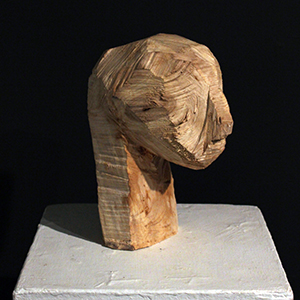
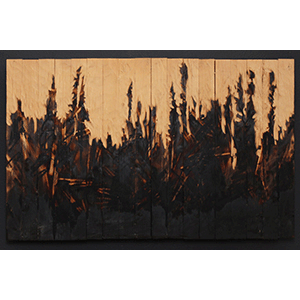
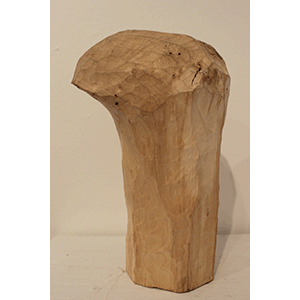
Alaska's haunting beauty is my inspiration. I was born in a town on the treeless tundra that cannot be reached by car and was raised in the state's interior region. The harsh climate illuminates the fragility and tenacity of life in the immense wilderness. I have a deep connection to this place but I have no aboriginal ancestry.
The roots of my sculptural practice can be traced to the driftwood masks made in the Yukon delta. When I was twelve I was taught how to carve in this living traditional style. I have been continually drawn back to this method of expression. The work of Alaska Native artists Kathleen Carlo, Lawrence James Beck, Ron Senungetuk, and Ron Manook and as well as archeologically unearthed anthropomorphic forms provided the foundation for my visual vocabulary.
I left home my third year in high school for the opportunity to attend an art school in Italy. I lived with a caring host family and communicated with gestures and drawings until I picked up Italian. I received classical instruction in art, and Michelangelo's partially finished figures left a permanent impression on my conception of process.
I returned home, finished high school and then flew east to attend Sarah Lawrence College. For three years I explored other media before allowing myself to reclaim sculpture. For my work to progress, I needed to resolve my conflictual admiration and apprehension about Picasso, Matisse, and Giacometti. Being raised by anthropologists in a cross-cultural community made me hypersensitive to symbolic misappropriation and I needed to separate myself from the Primitivists. I found solace in Jimmie Durham's proto-Marxist Indian Movement literature. I hope that my activism, ideology and personal history will prevent me from the pitfalls of Primitivism. Jacob Lawrence, Shepard Fairy, Guillermo Gómez-Peña, and iconic socialist prints and graffiti located across the globe give me confidence to be a visual activist.
My excursions into other media also honed my expressive ability and opened my eyes to artists who gave me new conceptions of beauty. The work of Thomas Hart Benton, Georgia O'Keefe, Francisco Clemente, and Keith Herring highlighted the idea that distilled imagery is poetic. Simultaneously, Chuck Close reinforced the power of revealing process.
I plan to continue exploring themes of identity and oppression while documenting the conflicts of society and nature. My work will continue to represent the tenacious and unpredictable power of survival and the whimsical beauty of life. If you are interested in exhibiting, purchasing or commissioning work please feel free to view my resume and contact me at jesse.hensel@gmail.com.
Jesse Hensel